|
Yale School of Music, July 28, 2026
After a 45+ year career as a music critic, educator, and consultant on classical music’s future, Greg Sandow ’74MM turned to his deepest artistic calling: composition. This August, the Acis label will release his Three Quartets, a new album with the Terra String Quartet, YSM’s 2024–2026 fellowship quartet-in-residence. The recording brings together three string quartets written at different points in his life and realized through a close collaboration with the ensemble.
Read More... |
 |
Anton Rubinstein: Piano Sonatas Nos. 1 and 2; Three Serenades. Han Chen, piano. Naxos. $19.99.
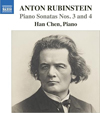
Anton Rubinstein: Piano Sonatas Nos. 3 and 4. Han Chen, piano. Naxos. $19.99.
Infodad, June 4 2026
That is a near-impossible feat for any post-Rubinstein pianist to accomplish, and it is to Chen’s credit that he undertakes it with such prodigious technique and enthusiasm…It is worth noting that Chen (born 1988) brings to the sonatas a kind of youthful vigor that fits their years of creation well.
Read More... |
 |
Crescendo Magazine, May 24, 2026
Han Chen, already acclaimed for his performances of Liszt and Busoni, tackles these two sonatas with a stylistic intelligence that deftly avoids the pitfall of mere virtuoso display… A project of rediscovery undertaken with admirable seriousness.
Read More... |
 |
Rémy Franck, Pizzicato, May 2026
Han Chen seeks not only the showy and virtuosic elements in Anton Rubinstein’s music, but also offers nuanced interpretations and a rich interpretive imagination. The result is a lively and engaging recording.
Read More... |
|
George Grella, New York Classical Review, May 08, 2026
It sounded like nothing else one has heard, and also exactly right for what was a historic night.
Read More... |
 |
Jean-Yves Duperron, Classical Sentinel, April 2026
…pianist Han Chen digs deep below the music's agitated and hyper-romantic surface and manages to extract its finer poetic details, buried under the flurry of notes in the thick of which he sails through without a hint of technical challenge.
Read More... |
|
Mark S Jordan, Seen and Heard International, April 4, 2026
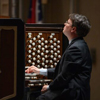
“Jacobs shook the hall with the organ’s stern attack, and Rustioni coordinated carefully with him to bring in the orchestra with whipcrack sting…Jacobs was commanding as he knitted together both agonized and meditative passages, culminating in a wrenching closing. He followed it up with a stunning encore, Bach’s Fugue in A minor, including a thrilling pedal solo near the end that brought the house to their feet. It served as a reminder that this magnificent instrument needs to be featured more often. We have had some lovely piano recitals this season, and it is time for an organ recital.”
Read More... |
 |
Peter Feher, Cleveland.com, April 3, 2026
“With the E.M. Skinner keyboards at his hands and feet, Jacobs was adroit, unfazed, and a force to match the Orchestra.”
Read More... |
 |
Mike Telin, Cleveland Classical, March 30, 2026
“For over a decade, organ virtuoso Paul Jacobs has been a frequent guest soloist on Cleveland Orchestra programs.”
Read More... |
|
Yukimi Song, The Piano Pod, March 24, 2026
|
|
Erika Dohi, New York Concert Review, March 24
"[Debussy's] Hommage à Rameau was the highlight of the evening. Mr. Nickell shaped the principal theme with elegant lyricism and expressive restraint, demonstrating attentive listening and musical sensitivity. The atmosphere in the hall reflected the audience’s focused engagement. The concluding Mouvement showcased Mr. Nickell’s technical facility, which was delivered with energy and precision."
Read More... |
 |
Rick Perdian, Seen and Heard International, March 14, 2026
“Oquin [was inspired] to create musical gems which may find a future as individual works in song recitals and choral concerts...Oquin displayed his skills as a choral composer in pieces as varied as his expansive, rambunctious ‘I Hear America Singing’ and his sensitive a cappella setting of ‘Then Last of All’. His urgent setting of ‘The Ship Starting’ was cinematic in scope and effect...He composed the soprano solos with Susanna Phillips’s creamy soprano in mind. She has long championed the composer, as has Tritle. Oquin set her voice like a gem, often with the harp as accompaniment, and it did shine...Oquin’s imaginative settings of the text are equaled by the exciting range of instrumental colors he employs in the score. [In the encore] he captures the innocence and wonder of Agee’s text with beauty, simplicity and sensitivity and the choir responded in kind...their pristine playing that Agee captured to perfection in the poem, and Oquin did so in music.”
Read More... |
 |
David Wright, New York Classical Review, March 12, 2026
“...touched with the poet's emotions and love of humanity...Tritle led his singers in three Oquin a capella works that have become staples of the choral repertoire...Composer Oquin introduced Sure on This Shining Night for chorus with violin and piano. Like Whitman’s verses, the tender poem by James Agee has been catnip for composers, notably Samuel Barber and Morten Lauridsen. In a delicate rendition Oquin’s version proved a worthy addition to this lineage.”
Read More... |
|
Geoffrey Wieting, Boston Music Intelligencer, March 10, 2026
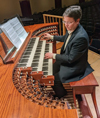
“Jacobs combined virtually infallible technique and heart-felt music-making while demonstrating exceptional physical mastery of an organ whose acquaintance he made probably less than a week before. This uncommon mixture of abilities, as well as his edifying and personal remarks to the audience, earned the vociferous approval of the sizable audience.”
Read More... |
 |
Walter Aparicio, New York Concert Review, March 9, 2026
"Ms. Rho’s interpretation of the Rachmaninoff Sonata was filled with exciting climaxes and a clear sense of overall structure. She shaped phrases beautifully and with care allowing them to develop organically. This reviewer was particularly struck with how Ms. Rho worked out the layered sonorities so clearly and how each line was handled with supple nuance. The work concluded with an exhilarating final movement, communicating a bombastic conclusion to the thoughtful program. I look forward to hearing Ms. Rho again in the future!"
on the bench, as all her energy went into tone production and phrasing, not gesticulation."
Read More... |
 |
David Wright, New York Classical Review, March 3, 2026
"The pianist’s imagination was such that no theme ever returned without viewing it in a new light, related to what had gone before… The most intimate sentiments could change to a flash of assertion in the blink of an eye. Even the most turbulent passages were digitally clear and shaped. Through it all, the pianist remained still and poised on the bench, as all her energy went into tone production and phrasing, not gesticulation."
Read More... |
|
|
|